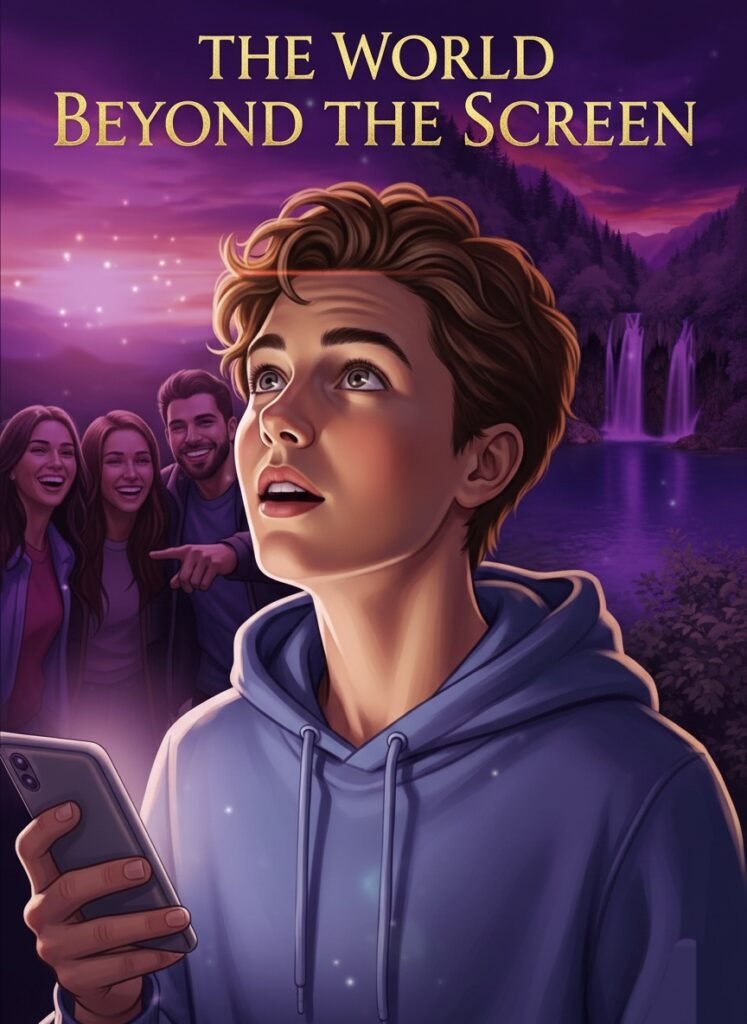
The World Beyond the Screen
Introduction: Are You Here? Imagine yourself sitting in a cafe with your friends. Everyone is laughing and talking, but you notice something strange. Each person is holding their phone, updating their page, replying to a message, or watching a video clip. Their faces seem to be lit by the screen’s light, but their eyes aren’t here. They’re somewhere else, in another world.Have you ever felt this before? Maybe you were the one holding the phone, or the person looking around wondering, “Am I the only one here?”There’s no doubt that smartphones are a magical tool. They allow us to access knowledge, connect with friends, and watch anything we want. But, have they also made us forget the real world? Have they stolen our precious moments with family and friends?This book is not a blame, but an invitation to reflect. It’s an exploratory journey to understand how these devices have become a part of our lives, and how we can restore balance. This book will help you be “here” again.Part 1: Life with a Filter
Chapter 1: The World in Your PocketTwenty years ago, communicating with friends relied on a landline phone or meeting at school. If you wanted to know something, you had to look for it in the library. Today, everything has changed; the whole world is now in your pocket.This rapid development has brought us countless benefits. We can now learn a new language through an app, communicate with someone on another continent, or even order our favorite meal with the press of a button. Phones have become an integral part of our lives, just like our house keys.But, like any powerful thing, this tool has another side. With every new notification, with every video clip posted, and with every message received, our attention is distracted. We live in a state of constant distraction.Have you noticed how many times you open your phone for no reason, just because you feel bored or empty? Have you considered how much time you spend in endless scrolling on the screen? This time hasn’t disappeared, but it has been taken from other things: from your time with friends, from your hobbies, and even from quiet thinking.The problem isn’t the phone itself, but how we use it. We’ve become addicted to quick “rewards” like likes and comments, which drive us to return to the screen again and again. In the next chapters, we will delve deeper into this, and we will see how we can regain control of our lives, step by step.
Chapter 2: Friends on the ScreenHave you ever felt like you’re surrounded by people but you feel alone? This is a very common feeling in our time. Smartphones have made communicating with friends easier than ever, but have they brought us closer to each other?With the press of a button, you can know what your friend on the other side of the world is doing. You see their new photos, their interests, and the places they visit. This seems wonderful, but the problem occurs when communicating with people through a screen becomes a substitute for communication in real life.We exchange messages and emojis, but we lose eye contact and body language. A screen cannot convey a real sense of comfort when your friend is sad, or a shared joy when an achievement is made. True friendship is built on shared moments, not just on notifications.Another effect is the Fear Of Missing Out (FOMO). This feeling makes us want to be constantly connected for fear that a party or event will happen and we won’t know about it. This puts us under constant psychological pressure; because we always feel that we are not in the right place, or that we are missing something important.Social media creates a cycle of comparisons. When you see “perfect” pictures of your friends’ lives, you might feel that your life is less fun or important. But remember that what you see on the screen is just a very small part of the truth, and it’s the part they only want you to see.Replacing real-life meetings with messages means we lose the opportunity to build unforgettable memories. No one remembers a text conversation, but everyone remembers a sincere laugh in a cafe or a shared adventure outdoors.Conclusion: You Have the ChoiceAfter all this, you might ask yourself: Is the phone a bad thing? The answer is no. The phone isn’t evil, it’s just a tool. The problem isn’t with the tool, but with how we use it.Imagine your phone is like a fast sports car. This car can take you to wonderful places and get you there quickly, but it can be very dangerous if you don’t learn how to control it. Phones are like this car; they give us access to a vast world, but they can make us lose our way if we are not vigilant.
Remember that you are in control. You have the power to decide when to use your phone and how to use it. You have the power to decide:When to put the phone aside and enjoy the current moment.When to turn off notifications to focus on studying or a hobby you love.When to leave the phone in your room and go for a walk in nature or play soccer.When to leave your phone in your pocket and talk to your friend without the screen interrupting you.The real world doesn’t disappear when you look at the screen. It’s waiting for you outside, with new memories, real adventures, and laughs that no screen can convey.Use your phone to be a window to the world, not a prison for you. You have the choice. Look up, look around, and remember that the real game, is life itself.
LAYAL 7☆7